

Building a GTM Story That AI Can Actually Execute
How to create a sales story system that sounds human, converts prospects, and scales without turning into generic AI slop



You’ve seen it. The LinkedIn comment that reads like a chatbot had a stroke. The Reddit reply that’s 400 words of nothing. The cold email that is so obviously AI-generated that you delete it before the second sentence.
We’re drowning in AI-generated content that sounds exactly like… well AI-generated content. Prospects know it. You know it. We’re all exhausted by it.
Quick note about my guest:
Florian authors The AI Sales Lab,real AI experiments for B2B sales, without the hype. He's spent 10+ years carrying quota and now tests what actually closes deals. Subscribe to him below.

Florian and I have spent months experimenting with AI in go-to-market functions. He’s been building sales story systems. I’ve been working on brand narratives. This article is what we learned when we stopped blaming the AI and started fixing our process.
Most AI-generated outreach fails for a simple reason. The AI has no context about your unique value proposition, your customer’s actual pain points, or the competitive landscape you operate in.
You’re essentially asking a writer to craft compelling sales messages about a product they’ve never seen, for customers they’ve never met, in a market they don’t understand.
The output reflects exactly what you’d expect from that scenario.
AI tools today are trained on vast datasets of “good” content. They basically reproduce patterns from that training data. Every tool converges toward the same style, the same structure, the same voice. Uniqueness diminishes. Differentiation disappears.
When everyone uses the same AI to create the same type of content trained on the same dataset, everything starts sounding identical.
Foundation First: Build Your Story Before You Scale It
Before you write a single AI prompt, you need a coherent story system. We use Donald Miller’s StoryBrand framework as our foundation because it forces clarity about who you serve and why you matter.
The framework is this:
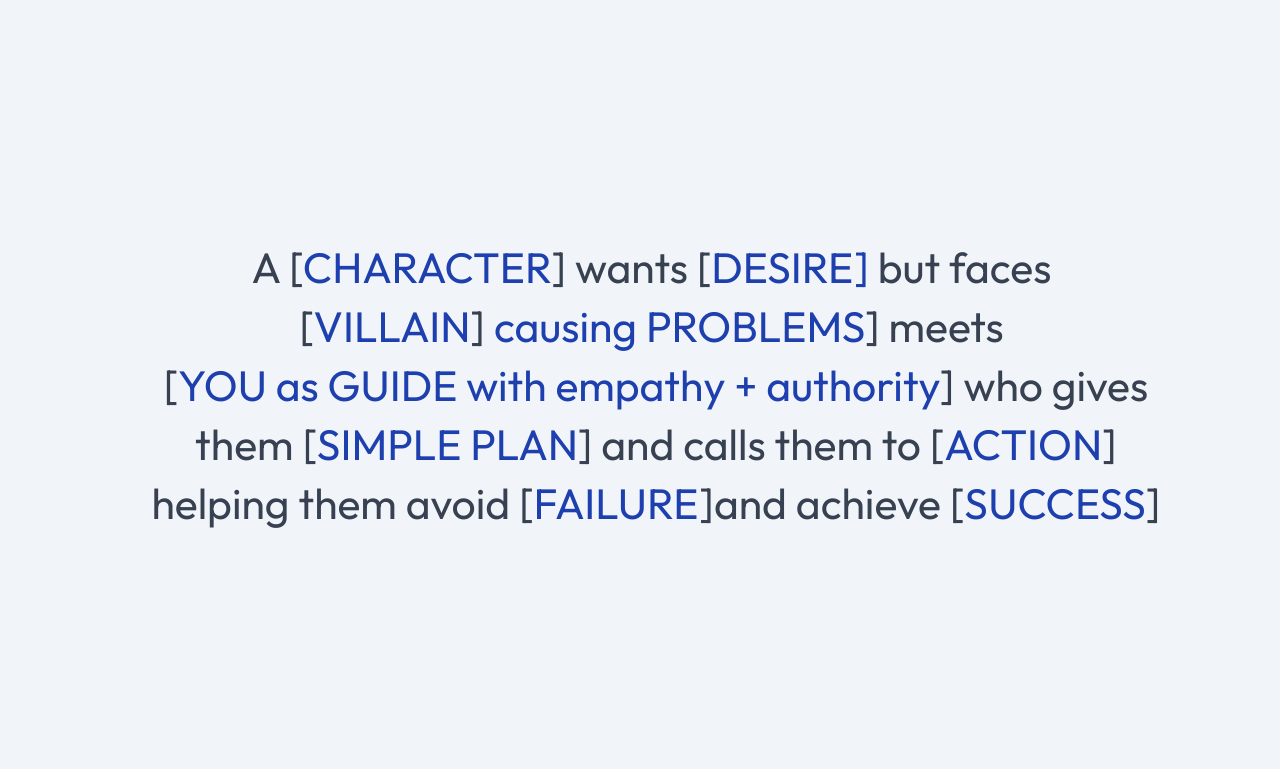
Let’s translate that into practical terms:
Character: Your customer (not you, not your product)
Desire: What they want to achieve (internal, external, or philosophical)
Villain: The specific force causing their problems
Guide: Your brand (showing proof points and category expertise)
Plan: Your methodology for solving their problem
Action: Clear next steps you want them to take
Failure: Consequences of inaction
Success: Outcomes when they follow your approach
This is an example for Substack filled out:
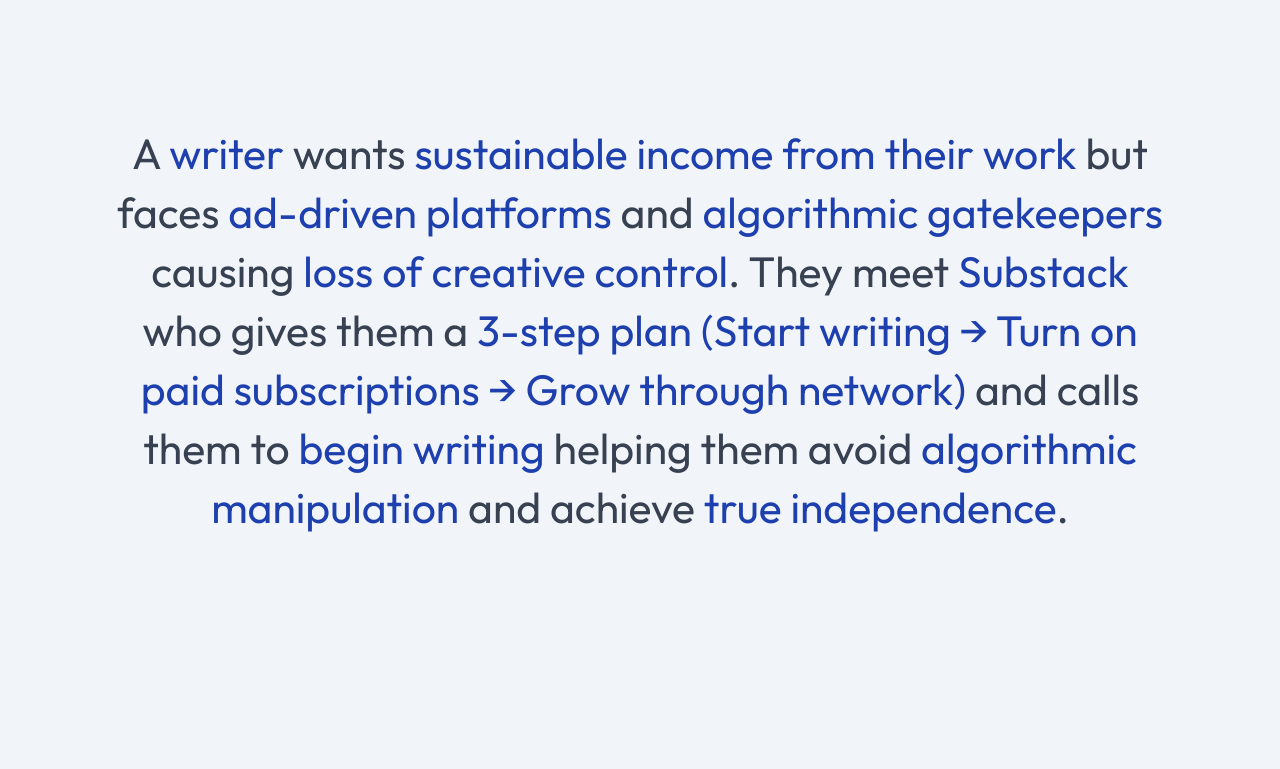
This becomes your narrative anchor. Every piece of AI-generated content should reinforce this story, not contradict it or dilute it.
Context is Everything: Build Your 3P Engine
Stop feeding AI generic keywords and vague instructions. Build a contextual foundation that gives AI the strategic reasoning it needs.
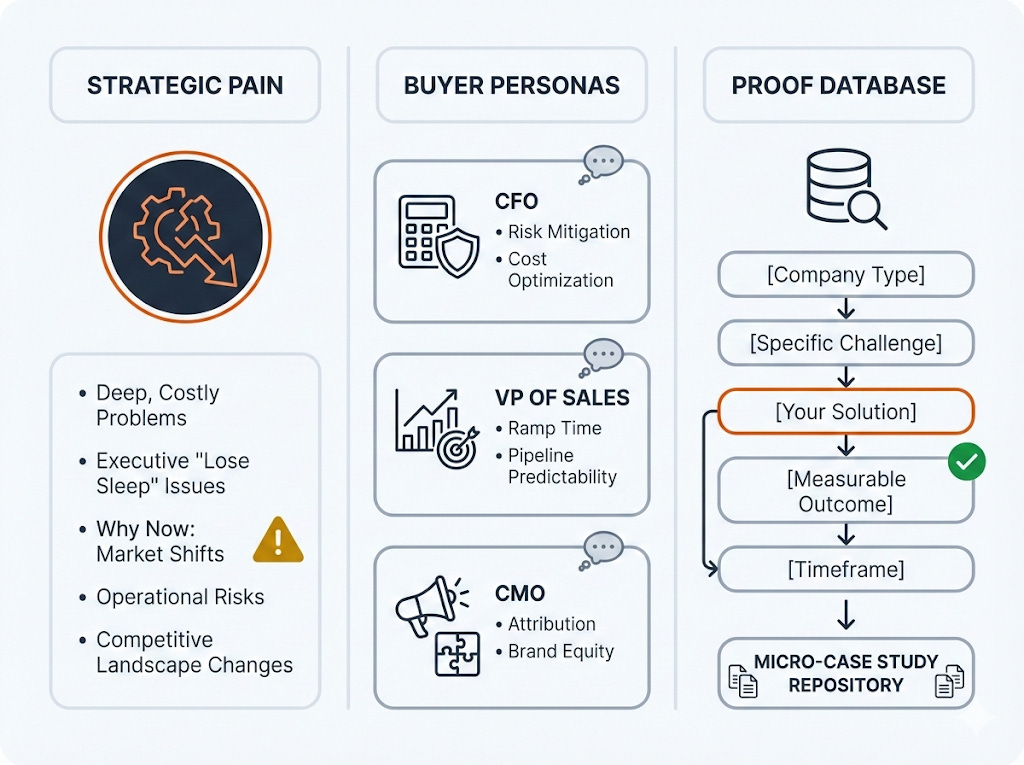
Your 3P Engine consists of:
Pain: The strategic pain points your customers face. Not surface-level irritations. Deep, costly problems that executives lose sleep over. Include the “why now” behind these pain points. What’s changed in their market, their operations, or their competitive landscape?
Persona: The psychological drivers of different buyer roles. A CFO cares about risk mitigation and cost optimization. A VP of Sales cares about ramp time and pipeline predictability. A CMO cares about attribution and brand equity. Don’t give AI the same messaging for different personas.
Proof: Your micro-case study database. Build a repository using this formula: [Company Type] + [Specific Challenge] + [Your Solution] + [Measurable Outcome] + [Timeframe].
Example: “Series B SaaS companies struggling with 45% sales rep churn implemented our onboarding system, reduced churn to 12% within 6 months, and cut ramp time from 4 months to 6 weeks.”
These become your reasoning foundations that help AI understand which pain points matter most for which personas, and which proof points will resonate in specific contexts.
Structure: Constrain AI With Proven Frameworks
Creativity without constraints produces chaos. Force AI to use proven narrative structures instead of freestyle generation.
For outbound emails: Use the Context-Value-CTA framework.
Context: Trigger observation that shows you understand their situation
Value: One specific pain point you can solve
CTA: Permission-based ask, not aggressive pitch
For discovery calls: Use the Hypothesis Model.
Take their stated benefits and invert them to find hidden problems
“You mention fast deployment. That suggests you’ve dealt with implementation delays before. What went wrong?”
For product demos: Use Tell-Show-Tell.
Tell: Recap their specific pain point
Show: Demonstrate the exact feature that solves it
Tell: Recap the business impact of this solution
These frameworks act as guardrails that keep AI focused on proven conversion patterns rather than wandering into generic territory.
Scale Through AI Interviews
Once you have your story foundation, your 3P engine, and your structural frameworks, you need a repeatable process for creating content at scale.
Templates produce template-sounding content. Instead, build an interview system.
Feed your AI project all the background context: your story system, your 3P engine, your frameworks, your proof points (and other relevant documents such as positioning, brand book, persona profile etc.) Then instruct AI to interview you about the specific content you’re creating.
Force AI to ask 5-7 strategic questions about the topic. Answer those questions in your own voice. Type your answers or record them as voice notes and transcribe them.
This approach captures your actual thinking, your unique perspective, and your authentic voice. AI then structures that raw material using your frameworks, maintaining consistency while preserving authenticity.
This works for webinar scripts, video content, email sequences, sales decks, or any content format. The interview ensures your perspective drives the content, not AI’s generic patterns.
Encode Your System for Consistency
The final step is making all of this repeatable and consistent. You need to encode your story system so AI references it automatically in every output.
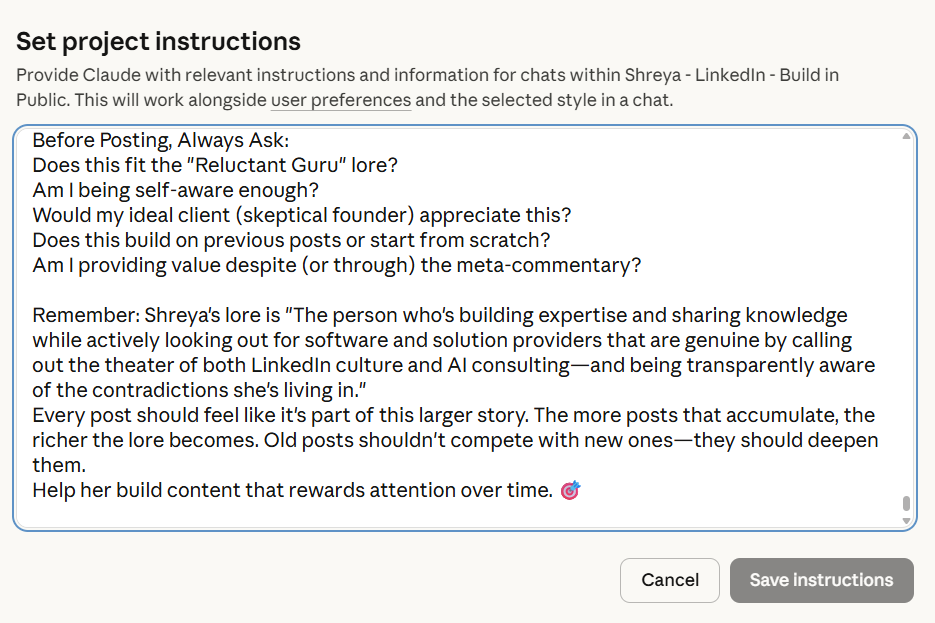
We embed specific instructions in our Claude Projects that reinforce the core narrative and challenge AI to evaluate its own output. This self-evaluation forces AI to consider narrative consistency, audience fit, and strategic positioning rather than just generating technically correct content. Your encoding should reflect your unique lore.
My positioning is about building expertise transparently while calling out performative aspects embedded in LinkedIn culture and AI consulting. Your encoding will reflect your market position, your differentiation strategy, and your audience psychology.
So this is what my system is encoded with:
AI can do everything…but
AI can structure your story, scale your messaging, and maintain consistency across channels. It cannot create emotional resonance.
AI doesn’t know what keeps your customers awake at 3am. It doesn’t understand the frustration of implementing yet another tool that promises transformation and delivers incremental improvement. AI hasn’t felt the relief when someone finally explains a complex problem in simple terms.
You have. Your story system must capture that emotional reality. Your 3P engine must reflect genuine empathy, not algorithmic pattern matching. Your frameworks must guide toward human connection, not just conversion optimization.
The AI story system we’ve outlined isn’t about replacing human insight with machine efficiency. It’s about encoding your hard-won expertise so AI can execute your strategy at scale without diluting what makes your perspective valuable.
Feed AI strategy, context, and constraints. It will give you consistency, scale, and efficiency. But the story itself? That’s still yours to create.
Want to support us?
Shreya breaks down what makes GTM stories work.
Florian tests how to execute them with AI.
Subscribe to both: one gives you the strategy, the other gives you the execution prompts.

 | A guest post by
|
Was very fun working on this with you. Looking forward for more!
The story system looks like a great framework. I’ll be trying it for sure.