

Decisions, Decisions, Decisions!
The anti-advice advice on choosing revenue vs positioning. And the question nobody actually asks before taking the money


“Money can definitely make anyone’s vision blurry.”
I said this to my co-founder somewhere between week three and week four of conversations with a government entity (in Belgium) about AI adoption.
Story-time!
Three weeks ago, Spryngbase (the company I am building/co-founding/developing - choose your verb haha) spent a significant chunk of time in those conversations. The management was excited. The employees however were resistant. And somewhere amidst the multiple discussions, we realized we were being hired to be something we had explicitly decided not to become.
A change management consultancy.
The marketer in me was screeching. Abort! Abort! This is not our positioning. Our positioning: we help SMEs understand AI by bringing employees along for the journey. The focus was on empowering employees with knowledge, keeping it vendor-agnostic, making the whole thing feel less like a corporate mandate and more like a skill they actually want. Change management consulting? That’s a different job. A respectable one. Just not ours.
And yet, the co-founder in me was leaning toward yes. Every cent matters in the first year.
Money, money, money, ain’t it funny… in a rich…
What makes this dilemma so insidious? The basic fact is that it would be a rational decision to take the contract. It came from our network, so sales overhead was low. The revenue could cover a month of runway. And honestly? We were curious. Could our thinking stretch to fit this context, even if the client wasn’t a perfect fit?
We mapped the scenarios.
Option 1: Take the contract, deliver AI consulting, get cashflow.
Option 2: Stay true to our product, walk away, protect positioning.
Option 3: Build some hybrid solution that magically does both (startup delusion, my favorite flavor.)
The real choice is always binary. You’re either building something repeatable, or something custom. Trying to combine both creates chaos. Confused, we turned to LinkedIn and Substack for help.
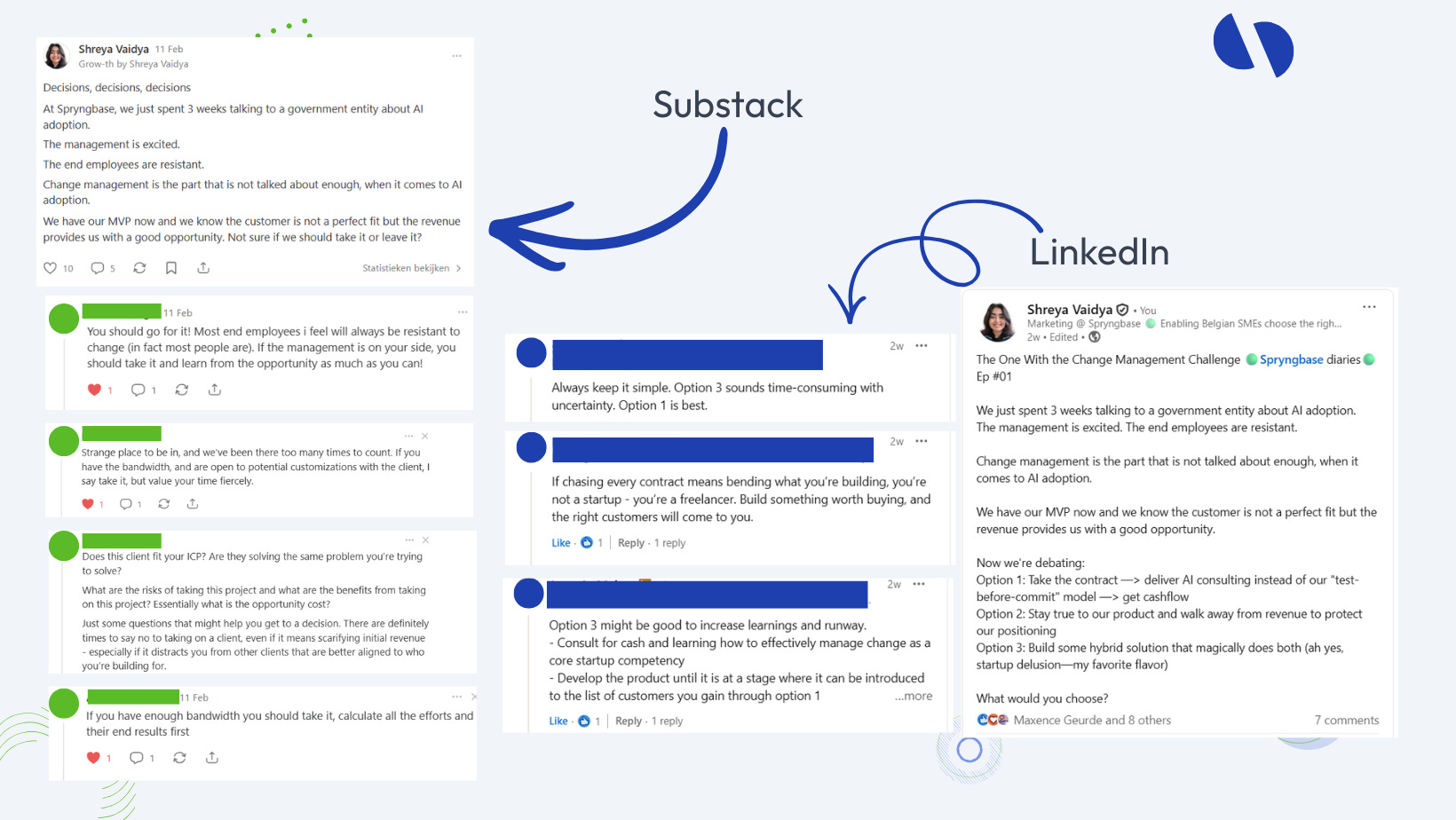
Some incredible feedback from the LinkedIn and Substack community members got us re-evaluating our decision. Multiple internal discussions ensued. Option 3 it is. We framed it as a controlled experiment. An outlier this deal shall be, not a pivot.
(Note: I have blurred the names and photos for privacy reasons but if you would like to show some appreciation to our advisors from our social media community feel free to do it here - LinkedIn & Substack)
Books fuel content📖📖 If mine helps you,throw one my way?
Should I stay or should I go?
Most startup advice bifurcates into two camps: stay focused or take the money and iterate. Neither is useful when you’re sitting across from an enthusiastic client who genuinely believes you can help them.
The sharper question however is this: How much does this revenue cost us in positioning clarity?
This question acts as an internal compass that tells your team what you are, what you’re not, and why that distinction matters when the next decision arrives.
If you’re a marketer reading this and thinking “I don’t have a startup, this isn’t for me.” I’d push back on that.
How many times have you been asked to adapt messaging for a customer success story that doesn’t fit your positioning, because the founder needed the case study? To build a campaign targeting an audience segment you’d never prioritize, because this quarter’s numbers needed padding? To write sales enablement material for a product vertical that’s strategically irrelevant, because someone upstairs saw an opportunity?
The pressure to compromise brand consistency for short-term revenue is not a startup-specific experience.
And I empathize with both sides, genuinely. Founders aren’t wrong to need revenue in year one. Marketers aren’t wrong to protect long-term brand coherence. The conflict is (fortunately or unfortunately) the structural feature of early-stage business that nobody warns you about with enough specificity.
Yes, and?
When we stripped away the noise and the guilt (yes, guilt, because this felt like it contradicted something we’d written down together as founders), we realized we were subconsciously running three tests. We’re making them explicit here, because they’re more useful than the binary everyone else is offering.
Test 1: The Fit Test. Does this client’s core problem align with the problem we set out to solve? For Spryngbase, the answer was a qualified no. Employees resistant to change imposed from management represents a structural problem. Not really a technological one.
Test 2: The Direction Test. Does solving their problem move us toward or away from where we want to go? We could see the shape of a solution, essentially something that eased the change management burden, bridged excited management and resistant teams. We could build that. But that company would be a change management consultancy with an AI wrapper. Know your specific distortion risk before you start.
Test 3: The Scale Test. If we said yes to ten clients like this, what company would we be? One misaligned client feels manageable. Ten of them? Not really. This choice, compounded over time, becomes your positioning whether you chose it or not.
Run the Scale Test early. It’s surprisingly good at cutting through the noise.
A bird in the hand
We’re taking the engagement. It covers runway for a month, it came from trust, and we’re genuinely curious about what we’ll learn from a client at the far edge of our positioning. But we’re doing it with our eyes open (extremely cognizant of the risks). We have also considered the cognitive overhead of working with a non-ICP client while simultaneously trying to find the ones who actually fit.
The bird in hand is real. We’re glad to have it. Although, we’re not pretending it doesn’t come with strings.
Spryngbase is building the simplest way for European SMEs to adopt AI by empowering the employees who’ll actually use it. This is Episode 01 of the Spryngbase Diaries, one messy decision at a time.
This is such conundrum, especially for a start-up. My article coming out tomorrow is closely linked to this subject. I've been advising startups for the last 10 years and I'd go for option 2 with full confidence but for such an early stage startup, learnings do matter. What I loved about your approach was the fact that you had already considered the overhead of working with a non-ICP. This tells me you're fully aware of the risks.
I wish you the best with this client and, hopefully, all the learnings will be well worth it.
Very insightful and definitely something startups can consider while battling the dilemma of pivoting entirely/ partially or not. Waiting for more such content -- Good luck!